9.1 Network Basics
Before getting into the theory of network layers, take a look at the simple network shown in Figure 9-1.
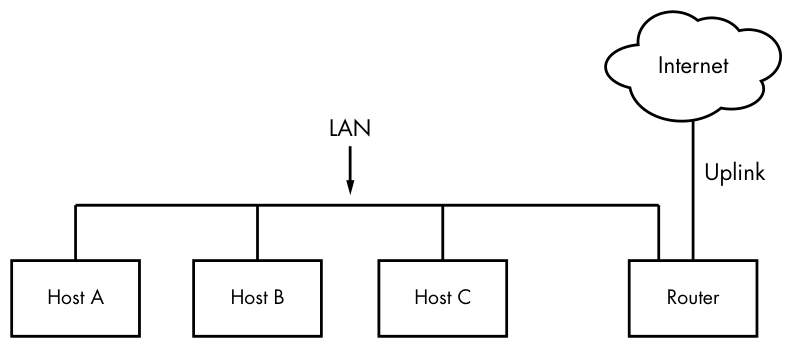
This type of network is ubiquitous; most home and small office networks are configured this way. Each machine connected to the network is called a host. One of these is a router, which is a host that can move data from one network to another. In this example, these four hosts (Hosts A, B, C, and the router) form a local area network (LAN). The connections on the LAN can be wired or wireless. There isn’t a strict definition of a LAN; the machines residing on a LAN are usually physically close and share much of the same configuration and access rights. You’ll see a specific example soon.
The router is also connected to the internet—the cloud in the figure. This connection is called the uplink or the wide area network (WAN) connection, because it links the much smaller LAN to a larger network. Because the router is connected to both the LAN and the internet, all machines on the LAN also have access to the internet through the router. One of the goals of this chapter is to see how the router provides this access.
Your initial point of view will be from a Linux-based machine such as Host A on the LAN in Figure 9-1.