10.9 Network Sockets
We’re now going to shift gears and look at how processes do the work of reading data from and writing data to the network. It’s easy enough for processes to read from and write to network connections that are already set up: all you need are some system calls, which you can read about in the recv(2) and send(2) manual pages. From the point of view of a process, perhaps the most important thing to know is how to access the network when using these system calls. On Unix systems, a process uses a socket to identify when and how it’s talking to the network. Sockets are the interface that processes use to access the network through the kernel; they represent the boundary between user space and kernel space. They’re often also used for interprocess communication (IPC).
There are different types of sockets because processes need to access the network in different ways. For example, TCP connections are represented by stream sockets (SOCK_STREAM, from a programmer’s point of view), and UDP connections are represented by datagram sockets (SOCK_DGRAM).
Setting up a network socket can be somewhat complicated because you need to account for socket type, IP addresses, ports, and transport protocol at particular times. However, after all of the initial details are sorted out, servers use certain standard methods to deal with incoming traffic from the network. The flowchart in Figure 10-1 shows how many servers handle connections for incoming stream sockets.
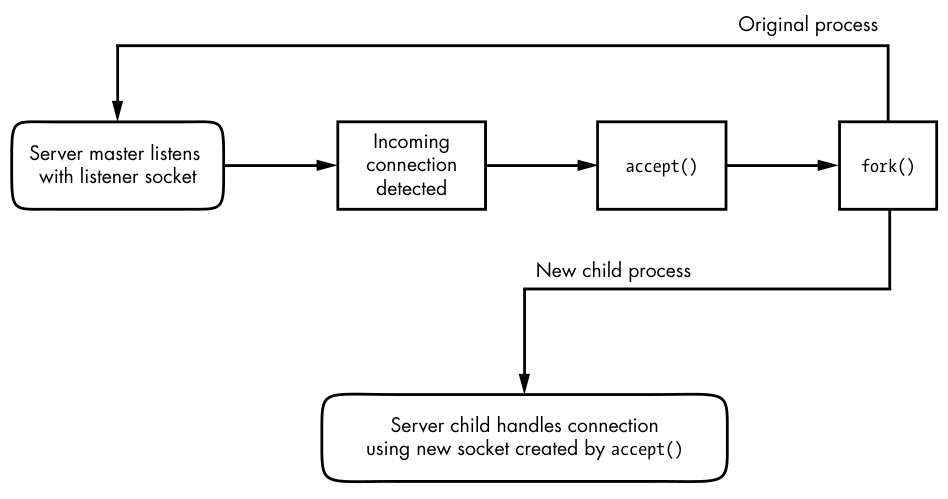
Notice that this type of server involves two kinds of sockets: one for listening and one for reading and writing. The master process uses the listening socket to look for connections from the network. When a new connection comes in, the master process uses the accept() system call to accept the connection, which creates the read/write socket dedicated to that connection. Next, the master process uses fork() to create a new child process to deal with the connection. Finally, the original socket remains the listener and continues to look for more connections on behalf of the master process.
After a process has set up a socket of a particular type, it can interact with it in a way that fits the socket type. This is what makes sockets flexible: if you need to change the underlying transport layer, you don’t have to rewrite all of the parts that send and receive data; you mostly need to modify the initialization code.
If you’re a programmer and you’d like to learn how to use the socket interface, Unix Network Programming, Volume 1, 3rd edition, by W. Richard Stevens, Bill Fenner, and Andrew M. Rudoff (Addison-Wesley Professional, 2003), is the classic guide. Volume 2 also covers interprocess communication.